
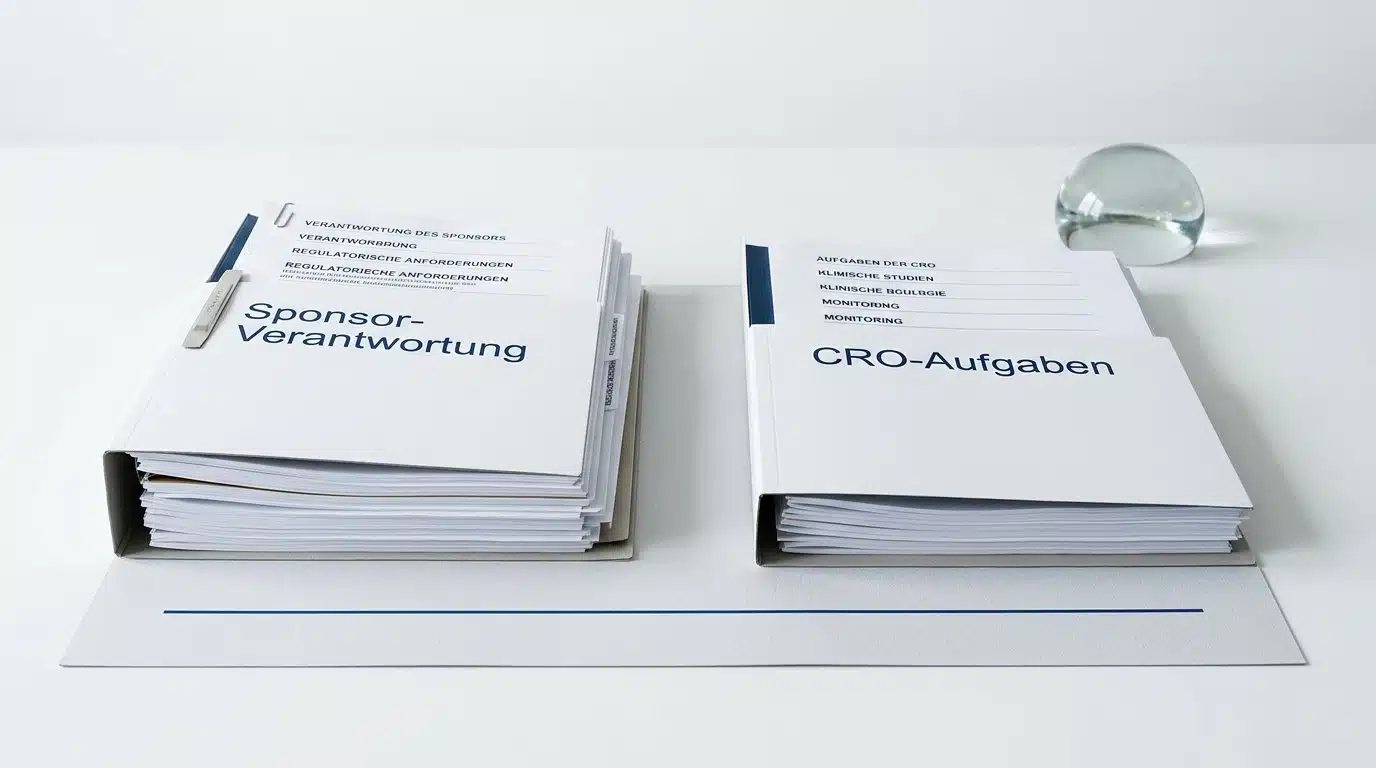
The overall regulatory responsibility for a clinical trial remains legally with the sponsor – even in the case of full outsourcing to a CRO. Monitoring, data management, statistics, and regulatory submissions are transferable. However, participant safety, data integrity, and pharmacovigilance remain the sponsor’s responsibility. In practice, this separation between the delegation of tasks and liability creates the most frequent points of friction – particularly when commissioning a CRO for the first time.
Key Takeaways
- Participant safety, data integrity, and pharmacovigilance cannot be delegated – regardless of the CRO mandate.
- Monitoring, data management, statistics, and regulatory submissions are delegable. Every task must be precisely specified in the contract.
- According to EMA GCP Inspection Metrics, a lack of oversight documentation is among the three most common sponsor findings.
The Sponsor: Legally Defined Overall Responsibility
According to the AMG (German Medicines Act) and ICH E6(R3), the sponsor bears the inalienable overall responsibility for initiation, financing, and monitoring – even when a CRO is fully utilized. Participant safety, data integrity, and approvals from the BfArM, PEI, and ethics committees remain in their hands, as do SUSAR reporting obligations.
Non-Delegable Core Duties
- Clinical Trial Protocol: Substantive responsibility for development, amendments, and scientific validity.
- Subject Insurance: Conclusion of the legally required insurance according to the AMG.
- SUSAR Reporting: Overarching responsibility for timely reporting to authorities and ethics committees.
The CRO: Operational Partner with a Clearly Limited Mandate
A CRO performs sponsor functions on behalf of the sponsor – not in their place. According to the ICH-GCP definition, it is an organization contracted by the sponsor to perform one or more trial-related duties. Monitoring, data management, biostatistics, medical writing, and regulatory submissions are delegable. Anything not expressly delegated remains with the sponsor. From a regulatory perspective, contractual gaps are at the sponsor’s expense.
Typically Delegated Areas of Responsibility
- Site monitoring by Clinical Research Associates (CRAs)
- eCRF setup, data entry, and data validation
- Preparation of clinical study reports and eCTD submission dossiers
Delegation ≠ Transfer of Liability
This is where the misconception lies, one that recurs annually in FDA Warning Letters: Biotechs with their first Phase III program sign full-service contracts assuming that they are also transferring regulatory liability. This is incorrect. ICH E6(R3) Section 3.6.6 states verbatim:

“A sponsor may transfer any or all of the sponsor’s trial-related activities to a service provider; however, the ultimate responsibility for the sponsor’s trial-related activities, including protection of participants’ rights, safety and well-being and reliability of the trial data, resides with the sponsor.”
Imagine the inspection scenario: The BfArM inspector requests the sign-off history of the Monitoring Visit Reports for the last 18 months. Only the CRO-internal approval is presented. The study continues. The finding ends up in the inspection report. Three months later, the regulatory authority strikes the primary endpoint – the reason: “inadequate sponsor oversight”. Three years of Phase III data, unusable.
The regulatory reality of this:
- During inspections by the BfArM, PEI, or FDA, the sponsor is liable for errors made by the CRO.
- GCP violations can render individual endpoints or entire datasets unusable.
- The EMA GCP Inspection Metrics Report has listed “inadequate sponsor oversight of CRO” among the top findings for years; FDA Warning Letters in 2022/2023 regularly cite 21 CFR 312.50.
Sponsor Oversight: What Active Supervision Looks Like Regulated
Sponsor oversight means: You demonstrably manage, evaluate, and control the CRO throughout the entire course of the study. Specifically, GCP requires:
- Vendor Qualification before contract conclusion: documented review of SOPs, quality systems, and references.
- Performance Monitoring: Regular KPI reviews, Risk-Based Quality Management, and documented escalations.
- Audit Rights: Contractually secured, including access to subcontractors.
- TMF Ownership: The Trial Master File remains your responsibility, even if the CRO manages it operationally.
Contractual Design: The StandVKlV Interface Risk is the Real Time Bomb
Anyone who concludes CRO contracts after December 2025 without StandVKlV mirroring is building a regulatory time bomb into their trial site network. The StandVKlV (Standard Contract Clause Ordinance), applicable to contracts concluded after December 17, 2025, regulates the contractual relationship between the sponsor and the trial site, not the sponsor-CRO contract. The gap arises at the interface.
If the CRO negotiates with trial sites on behalf of the sponsor, the StandVKlV obligations – reporting and insurance obligations, handling of IP rights – must be precisely mirrored in the CRO mandate. Otherwise, the trial site will refer to StandVKlV-compliant clauses that the CRO contract does not reflect – and the sponsor is left in the middle regulatorily. Authorities fundamentally view gaps or unclear clauses as a sponsor failure.
Division of Tasks in Practice
A robust division of tasks is established before the contract is signed – not during the course of the study:

- Responsibility Assignment Matrix (RACI): Unambiguously assign every sponsor duty.
- Escalation Paths: Record decision-making powers, response times, and contact persons in writing.
- Internal Oversight Resources: Maintain qualified personnel even in the case of full outsourcing.
- SOP Alignment: Check CRO standard operating procedures for compatibility with your QMS.
- TMF Documentation: Record oversight activities without gaps.
Support from Mediconomics
Mediconomics has been supporting clinical trials according to AMG, MDR, and ICH E6(R3) for over two decades in Europe, the USA, Switzerland, the UK, and Denmark – with submissions via CTIS, to the BfArM, PEI, and national ethics committees. Over 200 managed studies, more than 40 supported regulatory inspections without critical findings in the area of sponsor oversight.
The unique feature of our oversight model: We provide sponsors with a pre-filled oversight dossier that is ready for inspection at any time – with a traceable KPI history, co-monitoring logs, and a documented escalation chain. An inspection readiness check typically takes three to five business days with an existing dossier, instead of several weeks of reconstruction work.
Two typical configurations:
- Full CRO Mandate with Sponsor Oversight Package (monthly KPI reports, quarterly risk reviews, documented escalation matrix).
- Hybrid Model, in which the sponsor retains pharmacovigilance and regulatory affairs in-house, and Mediconomics operationally manages monitoring, data management, and biostatistics.
Consulting and implementation come from a single source. Schedule a free initial consultation.
Frequently Asked Questions
- Can a sponsor fully transfer the overall responsibility for a clinical trial to a CRO?
- No. The overall regulatory responsibility remains with the sponsor under all circumstances. Only tasks are transferable, not liability toward regulatory authorities, ethics committees, and trial participants. You must be able to prove at all times that you are actively controlling the study.
- Which tasks may a sponsor delegate to a CRO?
- Operational functions throughout the study lifecycle are delegable: site monitoring, clinical data management including eCRF design, biostatistics, medical writing, regulatory submissions (CTIS, eCTD), and operational project management. Participant insurance, protocol responsibility, regulatory approvals, and overarching pharmacovigilance, including SUSAR assessment, remain non-delegable.
- What happens if a CRO commits a GCP violation?
- The sponsor is liable to regulatory authorities. A real Phase II case: An internal sponsor audit three months before database lock revealed that the CRO had omitted Source Data Verification for 30% of the visits. The FDA later classified the affected datasets as insufficiently supported. The result: re-monitoring at the sponsor’s expense, a seven-month delay in the NDA submission, and the removal of a secondary endpoint from the final label. Had a regulatory inspector made the finding before the sponsor, the primary endpoint would also have been at risk.
- What must a sponsor-CRO contract mandatory contain?
- All delegated tasks explicitly and completely – ideally as an attached RACI matrix. Tasks not expressly transferred remain with the sponsor; inspectors view vague wording as a failure. Additionally: audit rights toward the CRO and subcontractors, defined escalation paths, KPI-based performance standards, reporting obligations, TMF regulations, and a StandVKlV-compliant mirroring of trial site obligations.
- What is sponsor oversight and how is it documented?
- Sponsor oversight refers to the active, continuous supervision of all delegated activities. It begins with the documented qualification check before commissioning – SOP review, audit, evaluation of key personnel – and continues throughout the entire duration of the study in the form of KPI reviews, co-monitoring visits, documented escalations, and an oversight file maintained in the TMF.